Short answer
Get appropriate medical care first; do not delay care to gather records. When it is safe, report the event to the property owner or manager, ask for a copy or reference number, photograph the condition and surrounding area, identify witnesses and cameras, and preserve footwear and damaged items. Do not sign a statement you cannot review or guess how long a condition existed.
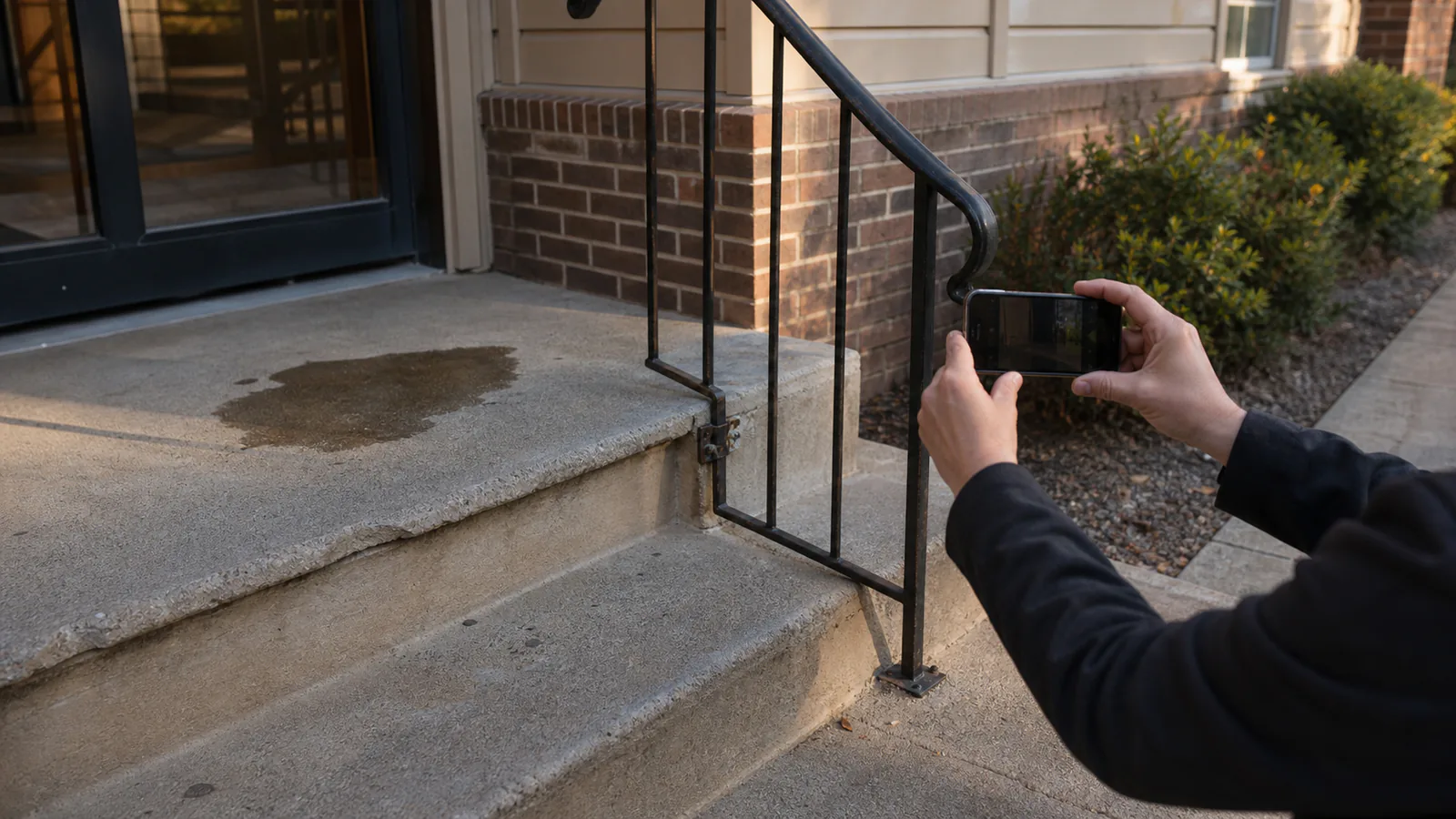
Capture the condition before the scene changes
Words such as slippery, broken, dark, crowded, or dangerous are a starting point, not a complete description. Note the material, size, color, lighting, slope, edge, water or debris, warning signs, nearby displays, weather exposure, and where your feet or body moved. Include a wider view so the close-up has context.
If you cannot photograph the area, write down what you remember and who was present. Do not return to a private or unsafe area without permission.
Help after an injury
Ask Jason Hicks about your next step.
When you are hurt, bills and insurance questions can be difficult to deal with on top of everything else. Ask for a conversation about the concern that brought you here.
Jason Hicks is an Oklahoma attorney, practicing since 2008.
Jason Hicks personally reads every message sent through 405. If more information is needed, Jason Hicks follows up himself.
The name over the door may not identify who controlled the area
A property may involve an owner, tenant, management company, maintenance contractor, cleaning company, security provider, vendor, or event operator. Save receipts, signs, uniforms, incident paperwork, and correspondence that identify the people and businesses involved.
Do not assume the name on the building identifies everyone who controlled the area. A lawyer can compare the contracts and records without turning an early question into a public accusation.
- Incident report or reference number
- Photographs of the condition and wider area
- Witness and employee names
- Camera locations and preservation requests
- Receipts, signage, correspondence and business names
Do not guess how long the problem existed
The timing of inspections, cleaning, repairs, complaints, weather response, or warning placement may matter. Those facts are rarely proven by guessing from appearance. Identify the records that may exist and preserve your observations without claiming how long a condition was present unless you know.
If an employee made a statement, write the words as accurately as you can and identify the speaker. Avoid paraphrasing it into a stronger admission.
Keep what changed—at the scene and in daily life
Keep the footwear and clothing in their post-incident condition when practical, along with photographs and purchase information. Save medical, work, travel, and out-of-pocket records. A short factual activity log can help explain changes over time.
Getting hurt on property does not automatically make someone legally responsible. But if the condition changed, cameras may be overwritten, several companies were involved, or no one will provide the incident report, those are reasons to ask Jason what evidence and questions deserve attention.
If a manager says there is no incident report or will not provide a copy, ask whether there is a reference number and who handles report questions. Keep the date, whom you asked and the words used in the reply.
If no answer arrives or no one can confirm whether a report exists, say that clearly. Keep your own observations, photographs and witness details separate from what the property supplied, so a missing reply does not become a guess about what happened to the record.
Make the question specific enough to answer
If the business will not show you its report or video, start with the particular record you need rather than a demand for every file. Give the business location, date, approximate time, and the part of the property where you were hurt. Name the incident report or the camera view you mean. Describe a camera you noticed without assuming that it captured the event.
Asking whether a record exists, asking that relevant material be kept, and asking for a copy are different requests. Make clear which answers you need and who handles each request. A report number does not tell you whether video exists or has been kept, and sending a request is not confirmation that it will be carried out.
Fictional example: A receipt shows a 2:18 p.m. purchase, and you remember falling near the side entrance before paying. The manager replies only that a report was opened. Use the receipt as a time reference, not an exact fall time. The unanswered questions are whether a camera covered that entrance around your visit, whether relevant footage exists, and who can address keeping it and sharing a copy.
Use the response to choose your next step
If a copy arrives, keep it as received and check whether it concerns the right event and location. Receiving a report does not answer a separate request for video. If you are directed to a manager or insurer, find out whether that contact handles access to the records or only the injury claim; a referral alone does not tell you which questions they can answer.
If access is declined, ask what the refusal covers: has the business found no record, declined to share one, or not yet checked? With no reply, follow up with the identified contact rather than supplying an explanation yourself. A refusal or silence alone does not tell you what a record contains, whether it was retained or destroyed, or who caused the injury.
You do not have to settle the access dispute before talking with a lawyer. Bring the request and any response so the lawyer can assess what is still missing and which lawful route fits. In an Oklahoma state-court lawsuit, discovery rules provide ways to request relevant documents and recordings, subject to legal protections and limits. That process is different from asking a manager for a copy; disclosure is not automatic.
What to gather
- Condition and surrounding-area photographs
- Incident report or reference number
- Witness, employee, manager and camera information
- Footwear, clothing and damaged-property condition
- Medical, work and expense records
Questions that may change the answer
- What exactly was the condition and where was it?
- Who owned, occupied, managed, cleaned or maintained that area?
- What inspection, warning, complaint, repair or camera records may exist?
- What observations are known, and what timing facts are still assumptions?
Common questions
Is a store incident report enough?
It is one record. Preserve your own photographs, witness information, medical record, receipts, and a copy or reference number for the report.
What if the condition was cleaned or repaired?
Keep any photographs and witness information you already have, and note camera and record locations. A changed condition does not make your original observations disappear.
Does getting hurt on property automatically mean the owner is responsible?
No. The condition, control, notice, warnings, conduct, causation, injury, and applicable law require a fact-specific review.
Why you can check the answer
See the law and official information behind this page.
These references support the general law, official process, or practical advice described here. They cannot decide how a rule, policy, document, or deadline applies to your particular facts.
- 405 editorial method
405 Injury Law neutral record-organization methodology (internal; not legal authority)
405’s internal method for organizing records, separating observations from inferences, and identifying the next question. It is not legal, medical, or insurance authority.
- Oklahoma law
Harrison v. St. Joseph's Regional Medical Center of Northern Oklahoma, Inc., 1995 OK CIV APP 61, 904 P.2d 146 (official external source)
This hospital-patient opinion distinguishes duties according to the injured person’s status and the specific relationship. It supports the need for individual premises review, not a report-access right or an unconditional rule drawn from the disputed invitee instructions.
Pinpoint: Paragraph5, read with paragraphs8–9: hospital-patient duty distinguished from ordinary entrant/invitee duty; conflicting invitee instructions were reversible error.
- Oklahoma law
12 O.S. §3226 — General Provisions Governing Discovery (official external source)
Oklahoma state civil discovery permits relevant requests subject to statutory scope, protections and court control. This does not determine the discoverability of a particular report or recording.
Pinpoint: A(1), B(1)(a), B(2), B(3), B(5), C(1)
- Oklahoma law
Oklahoma Statutes Title12 §3234 — Production of Documents and Things and Entry upon Land for Inspection and Other Purposes (official external source)
Formal Oklahoma state civil requests can seek documents and recorded information within the applicable scope, subject to procedure and objections. An informal request to a manager is a separate step.
Pinpoint: PDF printed pages528–530 (zero-based527–529), §3234 A(1)(a), B(2)(a)–(d), C; extracted lines23291–23371
See how 405 checks important legal and official information.