Short answer
Protect immediate safety first; leave health decisions to qualified medical professionals. Do not guess at a diagnosis, cause, duration, or future condition. Then preserve the beginning of the story: what happened, who was involved, what changed, and what each insurer or record says. Consider asking a car accident lawyer when an injury continues, accounts conflict, coverage is unclear, a commercial vehicle is involved, an insurer goes quiet, or one document could affect several parts of the matter. If the issue is only the vehicle, the property-damage guide can help you identify the next practical question.
First, keep the day from becoming a blur
Move away from immediate danger when you can do so safely and use emergency services when the circumstances require them. Do not enter traffic, confront another person, or delay urgent help to take photographs or collect paperwork.
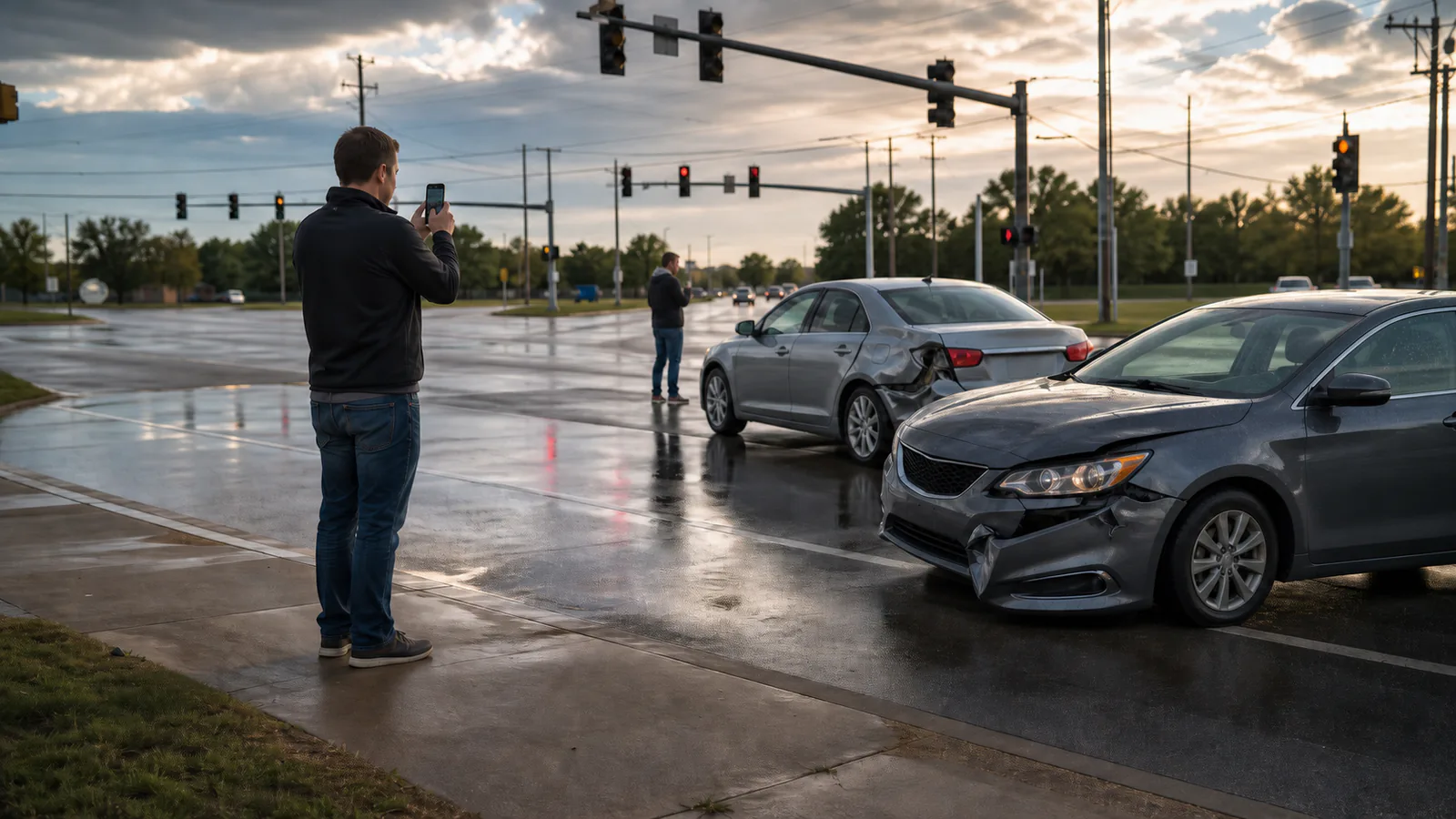
Once immediate needs are addressed, make a factual timeline. Identify the people, vehicles, exact location, photographs, witnesses, report information, towing details, and insurer contacts you can verify. Keep personal observations separate from statements made by someone else and from conclusions that have not been established.
Help after an injury
Ask Jason Hicks about your next step.
When you are hurt, bills and insurance questions can be difficult to deal with on top of everything else. Ask for a conversation about the concern that brought you here.
Jason Hicks is an Oklahoma attorney, practicing since 2008.
Jason Hicks personally reads every message sent through 405. If more information is needed, Jason Hicks follows up himself.
Separate disputed facts from disputed coverage
When someone disputes how the car accident happened, compare each account with photographs, reports, witness information, vehicle damage, messages, and other records. Label who supplied each statement and what remains unknown. Do not turn one report entry, diagram, or assertion into a final conclusion without examining the surrounding material.
A coverage question belongs in a separate section of the file. List every known policy, claim number, named person or vehicle, notice, reservation, denial, payment, and written explanation. A dispute about facts does not by itself answer a coverage question, and a coverage letter does not by itself decide what happened in the accident.
A request to attend an examination raises a different decision from a request to send a record. Use the examination-request guide to identify who is asking, the basis stated and the questions that need individual review. Do not assume that requests with similar titles have the same purpose or effect.
The shape of the crash tells you where to look
“Rear-end,” “intersection,” and “lane change” are only useful labels if they point to evidence. After a sudden stop, preserve the traffic sequence, distance and timing estimates, visibility, braking information, damage locations, and any earlier impact in a chain. After an intersection or turning crash, identify approach lanes, signals or signs, sight lines, turning paths, and possible video sources.
For a lane-change or sideswipe event, compare lane position, signals, mirrors or blind spots, contact points, and the movement shown in each account. For a hit-and-run or multi-vehicle wreck, preserve the order of impacts, vehicle descriptions, witness information, camera locations, claim notices, and any later identification record. The pattern organizes the inquiry; it does not decide fault.
- Rear-end, sudden-stop, and chain-reaction sequence
- Intersection, turning, signal, and right-of-way records
- Lane-change, merge, sideswipe, and contact-point comparison
- Hit-and-run identification and uninsured-motorist questions
- Multi-vehicle, vehicle-owner, employer, platform, or business involvement
If you were a passenger, start with the ride you know
Start with the vehicle you were riding in, rather than a checklist that assumes you were its driver or owner. Note the driver, vehicle, where you sat, and the part of the event you could actually see. Keep your own observations separate from another person's account. You do not need every owner's name or every policy before organizing what you have.
The passenger guide starts with the ride you actually took and the questions about your own injuries. A passenger may have information about several vehicles without being able to resolve responsibility or coverage. Keep a trip receipt or app messages when relevant, and use the rideshare or uninsured-motorist guide only for the question that actually fits.
If you are helping a child who was injured, the parent-and-child guide explains why practical caregiving, the child's own circumstances and authority to make a particular legal decision need separate attention. Do not assume that an adult's role in one task answers every other question.
One unfamiliar vehicle can change who holds the records
A public vehicle or employee, rideshare trip, commercial owner, unknown driver, several vehicles, or a fatal crash can add a party, policy, notice, or process question that is not visible in an ordinary claim number. Record the vehicle markings, owner, driver, employer or platform, trip or assignment information, and the source for each detail. Leave the classification open when it has not been verified.
If a delivery app, work assignment or business name appears, the delivery-activity guide explains why the actual activity and connections matter more than the label on the vehicle. The government-vehicle, rideshare and uninsured-motorist guides remain useful for their specific questions; none of those labels establishes a legal or coverage result.
After a death, the immediate family contact may also be coordinating records and insurance calls. The fatal-crash family guide separates those practical tasks from questions about claims and authority to act. It is a starting point for an individual conversation, not a rule for deciding which relative may sign.
Flag commercial-vehicle involvement early
If a commercial or work vehicle was involved, choose that subject in the review request. Use the list below as optional prompts for identifying details you already have and can safely verify. Keep those details for a later conversation if one is arranged; the form does not accept a written account or uploads.
The commercial and work-vehicle guide helps connect a driver, vehicle, business and possible record holder without assuming their legal relationships. Ownership, operation, employment and insurance may be separate questions. Individual review should identify which connection matters and what would support it, rather than treating a company name as an answer about responsibility.
- Company, carrier, vehicle owner, driver, and possible employer
- Cab, trailer, plate, vehicle markings, and identifying numbers
- Insurer, claim, towing, inspection, and repair information
- Trip, dispatch, delivery, or work-assignment details
- Known cameras, electronic records, and witness information
Use the Oklahoma City starting point that matches the record
Identify the agency or organization that actually created the record before choosing a portal. For an Oklahoma City police record, the current city records page is a different starting point from the state collision-report forms listed by Service Oklahoma. A report request, insurance exchange, and driver-filed report are also different tasks.
Keep the agency name, event number, report type, request date, payment receipt, and response together. Recheck the official page before relying on a form, fee, delivery method, or processing instruction because an external process can change.
If only the vehicle is involved, keep the problem practical
If the question concerns the vehicle, keep towing, storage, access, inspection, estimate, repair, valuation, rental, lender, title, and payment records together. Ask who controls access and inspection, what move or cost is proposed next, and request the vehicle, claim, amount, and document version in writing. A vehicle-only question can still become complicated when ownership, charges, valuations, or a release are disputed; use the property-damage guide for the focused task.
The financial question is bigger than the total
Bills and lost time at work may make the amount feel like the only issue. The compensation guide explains why responsibility, the connection to a particular harm, the governing law, available payment and agreement terms must be understood together. An inventory is useful evidence; it is not the same as an individual assessment.
A paycheck or business deposit can also hide the question that needs an answer. The missed-work guide separates work missed or changed from wages, used leave, business receipts and uncertainty about future work. It explains those distinctions without calculating damages or assuming that every effect is recoverable.
This is where individual legal judgment can add more than another checklist: identify which disagreement could change the decision, test the important assumptions and explain what an actual offer would resolve. The loss-record guide and settlement-and-release guide remain the focused owners for organizing support and examining the written proposal.
What the first review request can include
Choose the broad subject, optional timing, and question closest to yours, then provide safe contact details. Keep the accident date and place, who and what were involved, what changed afterward, which records exist, and what another person has said or requested for a later conversation if one is arranged. When preparing those private records, start with what you already have and note anything missing rather than guessing.
That later conversation may reveal a task you can finish yourself, a missing record worth pursuing, or a question that needs closer attention. Sending a request does not create an attorney-client relationship, set a response time, or promise an outcome. The form does not accept a written account or uploads.
For a later lawyer conversation, ask who would review new records, how updates would be handled, and what the written agreement says about fees, costs, and scope. Keep sensitive records out of the initial online request; discuss a suitable way to share them if a conversation is arranged.
What to gather
- Driver, vehicle, insurance, witness, and exact-location details
- Report identifier and scene or damage photographs
- Claim numbers and a dated communication log
- Commercial carrier, owner, employer, vehicle-marking, trailer, trip, and dispatch details when applicable
- Towing, storage, repair, rental, and valuation records
- Bills, insurer explanations, payment records, and work-impact records
Questions that may change the answer
- Which details are personal observations, and which came from someone else?
- Is the current problem insurer nonresponse, disputed facts, disputed coverage, ongoing injury, or a property-only issue?
- Has a payment, authorization, statement, or release been requested?
- Was a commercial truck, delivery vehicle, work vehicle, or fleet vehicle involved?
- Which record or decision is missing before the next step can be evaluated?
Common questions
When may a car accident lawyer help?
Individual review may be worth considering when injury continues, work is affected, accounts conflict, coverage is unclear, insurer communication has stalled, several parties are involved, or a requested document is hard to evaluate. Those signals do not decide whether a matter will be accepted.
What if the insurance company is not responding?
Keep a dated log of the claim number, contacts, requests, documents sent, replies, promised next steps, and follow-up attempts. That record helps distinguish an unanswered request from a disputed position without guessing why communication stopped.
What if my issue is only vehicle damage?
405 focuses on injury matters. If only the vehicle is involved, start with the property-damage guide to locate the car, understand the documents, and track transportation costs. The guide can help identify the next question without promising representation for a vehicle-only dispute.
What if a commercial truck or work vehicle was involved?
Select the commercial-vehicle option in the review request. Keep identifying details you already have for a later conversation if one is arranged; the form does not collect those details. They may help identify possible record holders without assuming responsibility or outcome.
Why you can check the answer
See the law and official information behind this page.
These references support the general law, official process, or practical advice described here. They cannot decide how a rule, policy, document, or deadline applies to your particular facts.
- 405 editorial method
405 Injury Law neutral record-organization methodology (internal; not legal authority)
405’s internal method for organizing records, separating observations from inferences, and identifying the next question. It is not legal, medical, or insurance authority.
- Official source
Service Oklahoma forms directory (official external source)
The State of Oklahoma directory used to confirm that collision-report and motor-vehicle record request forms are available.
- Official source
Oklahoma City Police records and permits (official external source)
Oklahoma City’s official police-records page, used to verify the local accident-record request path.
View 3 additional supporting sources
- Oklahoma law
Oklahoma Title 23: supported crash harm, future detriment and bodily-injury damages qualifications (official external source)
Official Oklahoma damages provisions supporting the distinction between recorded harm and legally supported compensation; this page does not apply a cap or exception to an individual injury.
Pinpoint: Sections 3-5, 61 and 61.3(A)-(H); official compilation pages 2 and 10-13
- Official source
Oklahoma Insurance Department how to file a claim (official external source)
Oklahoma Insurance Department claim guidance used for recordkeeping, broad claim categories, claim-disagreement paths, and consumer-assistance orientation.
- Official source
Brown v. Brown (official external source)
An Oklahoma Supreme Court decision used for the limited point that release wording and scope can matter and must be reviewed in the actual document.
Pinpoint: Syllabus 1 and paragraphs 3 through 4
See how 405 checks important legal and official information.